Charles
Lagendijk
Photography Eike Michler
Biography
Even at a young age, Charles knows that he is an artist.
It was in me from childhood. Fortunately, my parents kept my first little works. I looked at things in a very different way from other children my age.


Early on he goes his own way and does all kinds of things to develop his creativity. He copies paintings from his father’s art books and has piano lessons from Miss Voorn, who comes to the house to teach his sister the recorder. He keeps this up for only a few years, however. He takes leave of the teacher’s music lessons and roams the dunes for hours in search of inspiration, both for painting and for music.

As a teenager he works at various cheese markets around the country; the many dialects sound like music to his ears. Later he works in the vegetable department of a local supermarket, and so develops his love of cooking. According to Charles, cooking is also a form of art. Not only the vegetables themselves, but the dish too is something Charles can turn into something beautiful.


1985
Crete
At the age of 24 Charles moves to the Greek island of Crete. At first he works as a bar pianist, but this brings in too little, and by a curious twist of fate he is taken on as an independent cook in a Greek restaurant. In the evenings he single-handedly serves a meal to 40 to 60 tourists. By day he swims, fishes and … paints.

“I learned to deal with whatever came my way and to make something of it.”
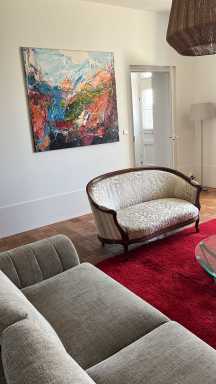
Charles wishes to convey this positive outlook in his work as well, and that is the main reason why he moved from figurative to abstract painting and eventually developed a form of his own.
“I do not want a fixed framework, but to tell the viewer a different story each time. A story that leaves the viewer with a happy feeling.”
After an eventful year on Crete, Charles returns to the Netherlands. Here he takes on various jobs to support himself, but above all to be able to keep painting and composing. From barman to pub landlord and from taxi driver to cleaner of bank buildings. All in the service of art.
Although these jobs bring in enough money, Charles finds no fulfilment in them. He therefore decides to give piano lessons, for which, being self-taught, he has completed a course in music theory.
Music, after all, remains his greatest source of inspiration. For him, every painting is an imagining of music. He gives careful thought to form, composition, colour and texture, searching for the harmony and melodic lines found in music and in landscapes. What you hear in music and what moves you, he also tries to convey in his paintings. “You have to fall in love with a painting, and then it will tell you its story,” says Charles.
Through composing large, abstract, colourful paintings, and with the help of the artist couple Toth Varju of Galerie De Boog, Charles develops into a successful painter.
From the 1990s onwards Charles exhibits frequently. He is represented by several galleries and is invited by galleries in Barcelona and Luxembourg. The crowning achievement of his exhibition work is an invitation to the Biennale in Florence.


The 21st century
Photography Eike Michler
Since the beginning of this century, Charles and several fellow artists in IJsselstein have organised an “open art Sunday”, on which members of the public can stroll along and get to know the various artists who live on the Walkade in IJsselstein. The accessible character of these art Sundays has turned many a passer-by into an art lover.
Since the beginning of this century, Charles and several fellow artists in IJsselstein have organised an “open art Sunday”, on which members of the public can stroll along and get to know the various artists who live on the Walkade in IJsselstein. The accessible character of these art Sundays has turned many a passer-by into an art lover.
Photography Eike Michler
Throughout all those years Charles composes music solely for himself, for who is waiting for yet another composer?
And then an up-and-coming talent in film directing asks Charles to compose the music for his first film. An exciting process that results in a particularly beautiful piece of music and leads Charles to decide to pursue it in earnest. Alongside the film score he composes various pieces of music, several of which are on Spotify and several of which have been performed by various musicians.


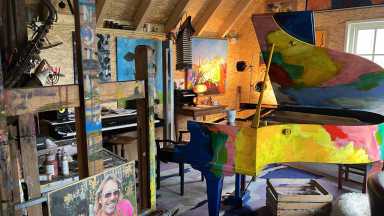
Since 2018 Charles has lived in Drenthe. He lives there with his wife on a small farmstead on the edge of the Dwingelderveld. He likes it so much that he has built a studio there where he can compose and paint. Charles’s work can be seen at various locations.

Photography Eike Michler